An Experiment in Social Media
Proposing a hypothesis and validating a prototype of slow social media.
When we first started talking about the idea that would grow into being Octothorpes, Nim and I had quite a lot of big, complex ideas about how it would work to create rich connections between people across their websites, enable collaboration, fix search indexes, solve discoverability, and avoid the pitfalls and traps of contemporary social media ecosystems.
We spent the years between 2022 and 2024 exploring the idea, doing Conceptual Labor, and working to understand what we were trying to do and why. The idea crystallized into a single question with the simplest possible shape:
“Why are feeds stressful, but libraries relaxing?”
ActivityPub, Twitter, RSS, Tumblr, Facebook, Instagram, an endless number of feeds with notifications and a constant stream to catch up with. Could we create a way to do social media slowly that felt relaxing and enriching as visiting a library? Could we create a community garden for people tending to their digital garden plots?
Can we create a calm, slow public space for social connection and collaboration?
Our Idea
On the internet, there is a clear social understanding of hashtags. If we create web rings for hashtags, we can use that to connect arbitrary web pages that add those hashtags to their content. This will allow us to create hashtag aggregation pages (like those on Twitter or Mastodon) that cross platform boundaries. The web ring will act as a community library that people can contribute to, filing their posts and articles and resources where they feel they fit.
Questions
- Do people understand the idea of hashtags when removed from the context of a social media app?
- Will people opt-in to add hashtags to their own websites?
- Does the end result feel like a feed or a library?
Prototype
We built the simplest possible structure and system for testing our idea and answering our questions.
If you add a hashtag to a web page, when the webpage loads it will ping the web ring and request to be indexed.
The web ring will index the page, and look for hashtags. The ring will store the page’s url and any hashtags it finds.
The web ring then exposes a user interface and a REST API for exploring the hashtags.
We cooked down the implementation of all this to the narrowest band we could, which looks likes this:
<link
  rel="preload"
  as="fetch"
  href="https://octothorp.es/?uri=<page-url-here>">

<link
  rel="octo:octothorpes"
  href="architecture">
Moderation, Trust, and Safety
Creating an aggregation system that gathers web sites and pages from across the internet has some inherent dangers, in that a large portion of the internet is horrible. Not only that, but some stuff that isn’t actively horrible can still not be right for any particular community — communities need to have boundaries, sovereignty, and agency in their norms and makeup. Anyone attempting to create community-oriented systems needs tools for moderation, however they intend to moderate.
For the prototype, any new domain that wants to participate in the web ring must be manually reviewed and approved. Any domain request, and any new hashtag, gets emailed to the administration team for that web ring. We wrote a short, intense, and clear terms of use page, and are able to delete anything from the web ring that violates these terms.
Evaluation
We took this prototype to the final XOXO Festival in Portland, Oregon in August 2024. Our goal was to talk to people about the project, introduce the concept to an audience that we felt was likely to adopt it, and get some answers to our questions. From the conversations we had with potential community members, we wrote blog posts to capture our learnings and messages that seemed to resonate with people. We are looking for pilot projects that might benefit from the hashtags the most, and working with those projects contributors to get the system running.
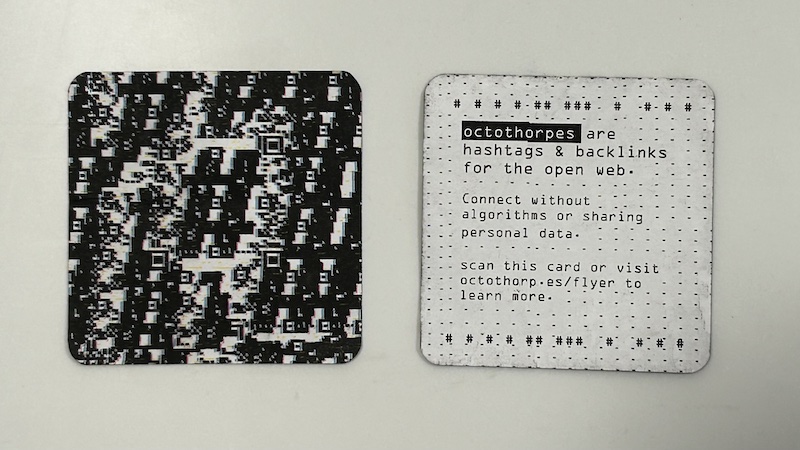
The Weird Web October project launched with our hashtags as the official way to share weird web projects. We wrote a site that used our API to collect the projects specifically. Our project got posted to Hackernews and Lobsters. People we do not know and did not speak with about the project are now using the hashtags and discussing the idea.
Results
Now that it’s in the wild, we can watch the system running – more or less as we intended! – and observe the broader conversation going on around the project to start answering our questions.
So!
Do people understand the idea of hashtags when removed from the context of a social media app?
Yes. This was a clear result, that the core idea of hashtags was durable enough to be separated from app-specific context. People seemed to understand the value and purpose of hashtags.
Will people opt-in to add hashtags to their own websites?
Yes. For the Weird Web October participants, they were happy to add the hashtags to their pages. Some people added the hashtags to their own blog systems and schemes. Some folks worked extra hard to figure out how to add them to new platforms like CodePen.
Does the end result feel like a feed or a library?
I think it feels right. The web ring is starting to feel more and more like a collection, a card catalog, and index of interesting things. Web pages are starting to become more discoverable and connected, without a sense of “getting left behind”. It feels like the hashtags won’t get lost, but will be there for finding when you want to find them. As the network grows – and we expand into multiple web rings — we can start adjusting the user experience and design patterns to push the system more towards “library”.
At the End of the Day
We feel like the Octothorpes project has the potential to be a radically different approach to social media than anything since 2007. We’re revisiting some good ideas from 2003 with everything we know about social networks in 2024. We think it has implications for replacing search, getting independent sites and blogs on the same footing as platforms, and foster a pluriverse of communities. This first small step into validating our ideas and learning from real adoption is helping us steer the project towards these big outcomes.